

The Ko-Dang/Juche Pattern Change
An exploration of the people and ideas who inspired these patterns and why they were changed.

Ko-Dang is the pseudonym of Cho Man-Sik, who was born on 1st February 1883, in a strongly Christian village, Kangso-guyok, in South Pyongan Province, in what is now North Korea. He was raised in a Confucian style, but converted to Christianity and became an elder in the Protestant church, and an activist within Korea’s Christian Movement.
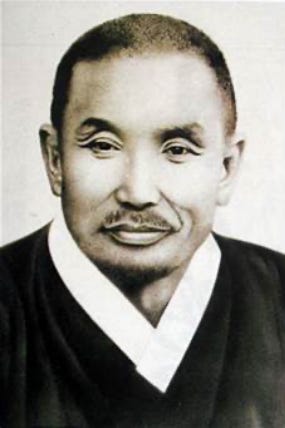
During Korea’s occupation by Japan, Cho Man-Sik went to study in Tokyo, Japan. It was while studying law at Meiji University from 1908 to 1913, that Cho first came across and was inspired by Gandhi’s ideas and writings on self-sufficiency and non-violent resistance to oppression. When Cho returned to Korea, he was influenced by the likes of Ahn Chang-Ho (Do-Sang), and this influenced his becoming involved in the Korean Independence Movement. It must be pointed out, that during the Japanese occupation, Cho was less well known and less mentioned than Ahn Chang-Ho, who, unlike Cho, was known to use violent measures.
Cho’s activism helped pave the way for the proclamation of the Declaration of Independence by the Korean Youth Corps in Tokyo on Feb 8, 1919, and he later publicly challenged the colonial order that Koreans change their surnames for Japanese ones.
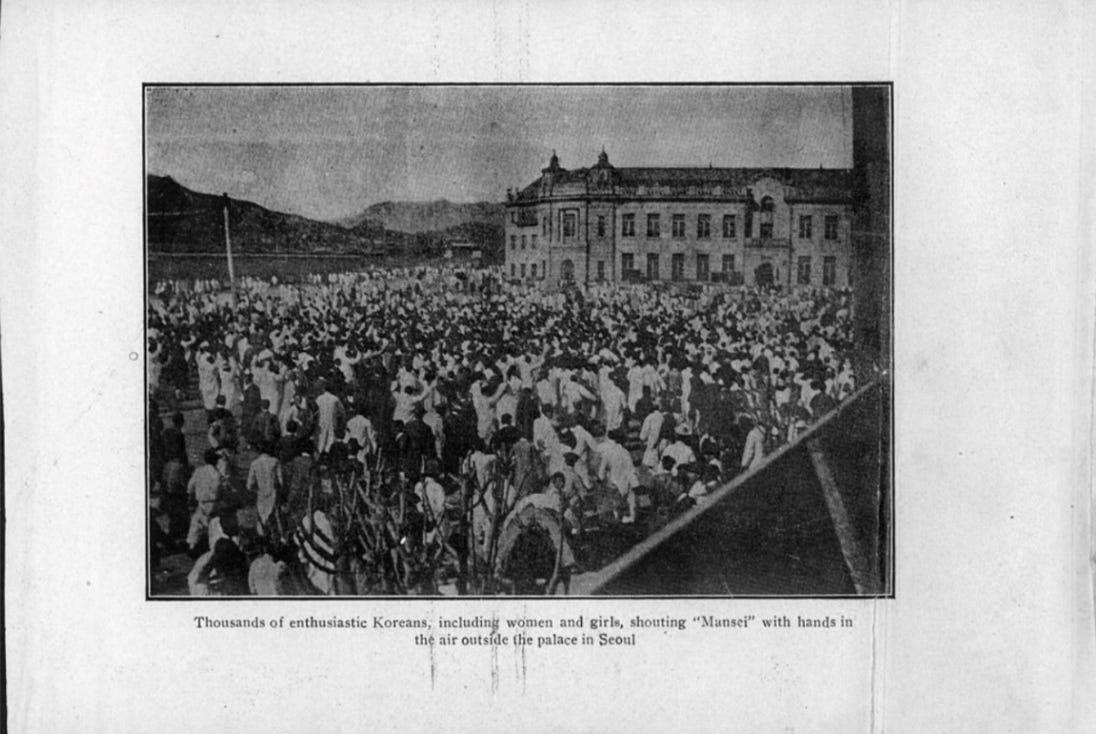
Cho also took part in the famous March 1st Movement, which was also known as the Sam-Il Independence Movement, which was a series of demonstrations for national independence from Japan that started in Seoul on March 1st, 1919, and quickly spread throughout the country. Around 2,000,000 Koreans took part in the more than 1500 demonstrations in Seoul and other cities, 7500 were brutally killed by the Japanese police and army, and 16,000 were injured. Cho Man-Sik was one of 46,000 who were arrested for taking part in the demonstrations. These protests were some of the first public displays of Korean resistance to Japanese rule in Korea between 1910-1945. South Korea, on May 24, 1949, actually designated March 1st as a national holiday. In another commemoration, General Choi Hong-Hi dedicated the first of three patterns, (Sam-Il tul), trained by 3rd degree black belts, to the Sam-Il Movement.
Cho Man-Sik was often called the ‘Ghandhi of Korea” and he established the ‘Korean Products Promotion Society’ in 1922 hoping that Koreans would obtain ‘economic self-sufficiency’ and rely solely on Korean produced products. He advocated “Sticking to Korean made products that will save the nation’s economy.” Cho even gave up wearing Western clothes, and just wore the Korean hanbok for the rest of his life, truly showing his belief that Korean made products are a sign of loving Korea.
Through this Cho hoped to generate a sense of nationalism, and he hoped for the Korean Products Promotion Society to be a national group supported by ordinary Koreans, all religious organisations and all social groups. Cho was influencing Koreans, based on his moral example rather than his political or social standing, and by mixing ‘traditional commoners’ values with the practical elements of the Western religious and scientific outlook,’ he gathered huge support.
In August 1945, Japanese surrender was approaching, and the Japanese Governor of Pyongyang asked Cho if he would assemble a committee to take control and maintain stability in the area. Cho said he would, and the Provisional Peoples Committee for the Five Provinces (PPCFP) was created on 7 August 1945, of which he became Chairman. He also joined the cabinet of the Peoples Republic of Korea making the PPCFP its Northern Branch. Cho also affiliated this committee to the Committee for the Preparation of Korean Independence. The PPCFP is generally made up of right-wing nationalists opposed to communism.
The USSR (Russia) arrived in Pyongyang just days after the Japanese surrender as had been agreed with the USA, who arrived in the South to assume control there while Russia took control in the North, meeting at the 38th parallel which now permanently divides North and South Korea.
The Russians, on their arrival, tried to convince Cho Man-Sik to lead the emerging North Korean administration. Cho, however, didn’t like communism and had no trust in foreign powers. He came under a lot of pressure from the Russians to reorganise the councils so there were more communists on the committees. Because of this, Cho, who was the first ‘real’ leader of North Korea was forced to share power with the Russian backed Kim Il-Sung. Kim had trained in both the Soviet and Chinese Communist Armies, and he and Cho had such vastly different ideologies that this led to a lot of tension and clashes between them.
The Moscow Conference in 1945 saw the victorious Allied powers agree to run Korea under a fourpower trusteeship (USSR, USA, UK, China) for 5 years, after which it would become an independent state. On 1 January, 1946, a soviet leader, Andrey Romanenko, met with Cho and tried to persuade him to sign his support of the trusteeship. He refused to sign, as it meant to much foreign, and particularly communist influence on Korea. Soviet leaders were unhappy with Cho’s refusal to sign, and his open protests about war crimes committed by the occupying Soviet force.
On 5 January 1945, Cho was arrested by Soviet soldiers, and taken to Koryo hotel in Pyongyang under house arrest, where he was held for some time. While there he continued his vocal opposition of the communists. He was later transferred to prison in Pyongyang after an unsuccessful Vice-Presidency bid in the 1948 election while still being detained at the hotel! By then the communist hold on the community was so strong Cho only received 10 votes from the National Assembly.
Days before the Northern Korean invasion of Southern Korea in June 1950, the two governments reached a provisional agreement to exchange prisoners Cho Man-Sik and his son for two South Korean Workers Party leaders, Kim Sam-Yong and Yu Ja-Ha. However, the method of exchange could not be agreed upon, and on June 24th, after the start of the war the next day, Kim and Yu were executed in Seoul.
Cho is believed to have been executed in early October 1950 with other political prisoners, in the early days of the Korean war. The North Korean Former Ambassador to East Germany, and now defector, Park Gil-Yong stated Cho was ‘killed by the Korean People’s Army in a massacre of 500 people’. Here, using a quote I found from a 1991 interview in the Korea Herald, Park Gil-Yong explainsthe circumstances of Cho’s execution: “After retreating from Kanggye, North Pyongyang Province, I heard from the leadership that on the night of Oct 18, while the Peoples’ Army fled from Pyongyang, approximately 500 people were shot to death at Pyongyang Prison. Among the corpses, some were buried in a hastily dug hole at the Daegong riverside, including the body of Cho Man-Sik. Most of the bodies were simply abandoned.” (Park Gil-Yong)
(I must point out that while the Korea Herald says 500 prisoners were killed, during my research I found discrepancies with this number e.g., Wikipedia says Cho was one of 5000 prisoners killed).
Cho Man-Sik’s life and legacy continue to speak hugely of North Koreas troubled political affairs. He is remembered for his work against Japanese colonial rule in Korea, for his fight against the division of Korea and for freedom from communist rule. His drive for independence was so strong he had written in his will “When I die, please draw two eyes on my gravestone, I am determined to see Japan collapse even after my death.” Cho Man-Sik is admired for living only for Koreas independence, and for the people of Korea.
In 1970, Cho Man-Sik was declared a martyr by the South Korean Government, and posthumously awarded the Order of the Republic of Korea, in recognition of his contribution to his country.
General Choi Hong-Hi, the founder of ITF Taekwon-do, created a Taekwon-do pattern named after Cho. ‘Ko-Dang is the pseudonym of the patriot Cho Man-Sik, who dedicated his life to the Korean Independence Movement and to the education of his people. Ko-Dang has 39 movements which signify his times of imprisonment and his birthplace on the 39th parallel.’ It was one of the original 24 patterns created by General Choi, but, in 1980 was removed from the official syllabus by Choi and replaced by a new pattern, Juche.


General Choi was a founding member of South Koreas armed forces. However, after serving on the military tribunal in the court marshalling of his then military junior General Park Jung-Hee, (who later become South Koreas President), where Park was given a death sentence which was later rescinded, there were definite tensions between General Choi and General Park. Following a military coup in 1961 where General Park took power in South Korea, General Choi was sent to Malaysia on Diplomatic Assignment as Korean Ambassador in 1962. He returned nearly 3 years later, in late 1964, and stayed in South Korea until 1972 when he was forced to flee to Canada to live in exile. Once there, Choi relocated the headquarters of the ITF to Toronto.
From Toronto, General Choi continued to publicly voice opposition to the dictatorship in Korea. The South Korean Government formed WTF in 1973, and the military regime there used their power to put enormous pressure on the loyal Korean ITF instructors. Pressure also came from the KCIA towards Korean master’s and their families. This caused an exodus of ITF instructors to join WTF. The students Choi had personally trained in Korea had become Masters, and been sent by Choi all over the globe, but one at a time they had been bought by or switched to the WTF. By 1980 only 10 were still with Choi.
He assembled a small team of 15 people at this time, including his son and son-in-law, to visit North Korea. This trip was meant to spread Taekwon-do as General Choi believed TKD to be for all nations, but it was also to gather funds for ITF. Choi was happy to see, that interest in ITF taekwon-do was very strong in North Korea – 30,000 people turned out to watch the demonstration, and furthermore Kim Il-Sung covered the cost of the trip, and offered Choi millions and gave the promise that Taekwondo would be taught in North Korea.
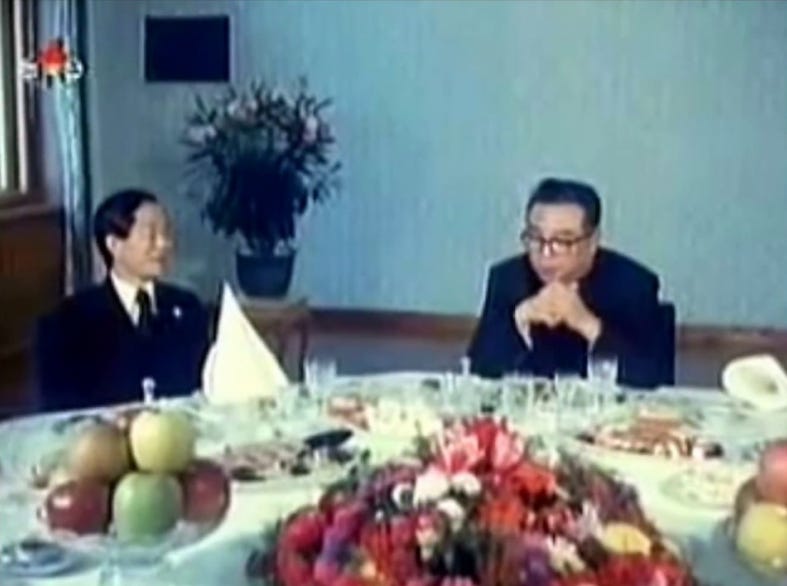
When asked, in an interview in 1999, why Juche had replaced Ko-Dang, Choi Hong-Hi replied – “As new techniques were developed, they needed to be represented in the patterns. The pattern Ko-Dang was replaced simply because it represented the latest Korean history, basically last in first out.
Since General Choi Hong Hi and President Kim Il-Sung the new techniques are difficult to perform, (ie dodging reverse turning kicks, slow motion kick/ reverse kick consecutive kicks, mid-air strikes, defensive hooking kicks, 2 directional kick, landing in a left diagonal stance while performing a block) they should come in at the 2nd Dan Black Belt level, as that is when one can be in peak condition.” Judging by this interview, General Choi thought Ko-Dang was too simple to be challenging enough for 2nd Dan Black Belts. Unlike Juche, which is a much more complicated pattern, and really tests the practitioner on their physical skills and their ability to perform complex movements while still looking controlled and flowing.
Other conclusions have also been reached as to why General Choi replaced Ko-Dang with Juche. The consequences for Choi’s team trip to North Korea were huge. As he had been a General fighting North Korea in the Korean war and taught anti-communism to South Korean soldiers, many in South Korea now felt he was providing the North Korean Army information he had taught to the South Korean army. They wondered whether he was supporting the Communist regime.
While in North Korea General Choi was allowed to visit his birthplace, Kangso-guyok, which he hadn’t seen since after the second world war. Since the war it had been restored back to its natural beauty.
To thank President Kim, General Choi gifted the North Koreans a new patten named Juche. It was to be put in the place of Ko-Dang, which would be removed, as Ko-Dang, (Cho Man-Sik) was once a political rival of Kim’s. Kim is, in fact, rumoured to have ordered his execution. It goes without saying Kim wouldn’t have given any funding to ITF if Ko-Dang remained in the patterns, portrayed as he was, an honoured hero. In fact, Kim wanted Taekwon-do to be renamed Juche Taekwon-do after his own nationalist ideology.
Today in dojangs and competitions world-wide, we yell “Juche!” when finishing this pattern, in a salute to North Koreas ideology whether we intend to or not.
In Juche tul, the pattern meaning states; ‘Juche is a philosophical idea that man is the master of everything and decides everything. In other words, the idea that man is the master of the world and his own destiny. It is said that this idea was rooted in the Baekdu Mountain which symbolizes the spirit of the Korean people. The diagram (M) represents Baekdu Mountain.’
Juche, officially ‘the Juche idea’, is the state ideology in North Korea. The first documented use of Juche as an ideology was in 1955 in a speech by Kim Il-Sung, given to promote an elimination of pro-Soviet and pro-Chinese elements from the Workers Party of Korea (WPK) after a failed challenge against his leadership, and was later to become known as the Juche speech. However, Juche was not adopted as the basic principle of North Korean politics until 1965. ‘On the Juche Idea’ is one of North Koreas most complete and recognised works on Juche, and was published under his son, Kim Jong-Il’s name in 1982. The WPK is responsible for educating the people in the ways of Juche thinking, which is tightly linked with Kim and represents the guiding idea of the Korean revolution.
Importantly, loyalty to the leader is an essential part of Juche, as is clearly shown in North Koreas ‘Ten Principles for the Establishment of a Monolithic Ideological System’. These principles order complete loyalty to Kim Il-Sung, his successor Kim Jung-Il, and later still Kim Jong-Un entrenching them as the supreme political authorities. The Ten Principles have replaced the North Korean constitution and edicts put forth by the WPK, in practice they serve as law in the country. Every citizen must memorize them.
Juche is so indoctrinated in North Korean thinking, that the system of year numbering is even on a Juche Calendar, which was adopted in 1997, 3 years after the death of Kim Il-Sung. The calendar starts at the year Juche 1, which on the Gregorian calendar is 1912, which is Kim Il-Sung’s birth year.
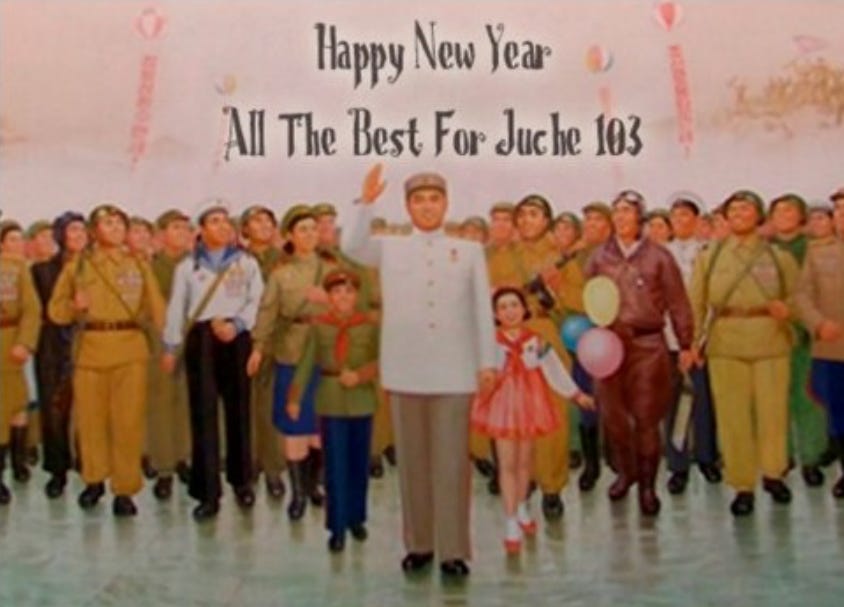
It could even be said that without funding from Kim Il-Sung the ITF may have had trouble surviving, as multiple other countries had already turned down approaches from General Choi. Perhaps this is why Choi went so far as to pay a silent tribute to Kim Il-Sung in the Juche ‘Ready Posture’. It cannot be denied, that when comparing the Juche ready posture to photos of Kim Il-Sung, that it resembles his standing stance! And perhaps the 45 moves in the pattern are a reference to the year 1945, the year Northern and Southern Korea were split, which in turn lead to Kim Il-Sung being in power and eventually leading to the Juche Idea?
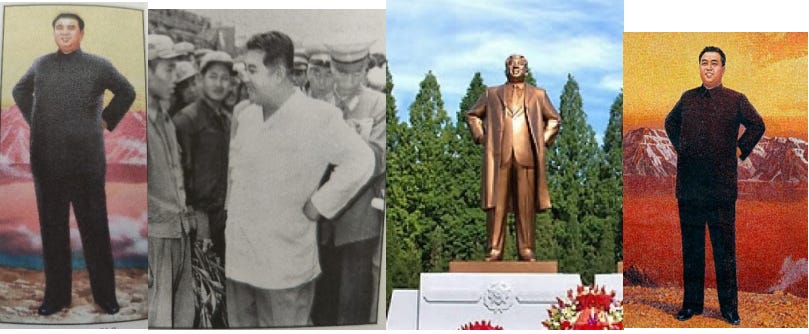
Because of this, I, personally, find it difficult to feel comfortable practicing a pattern, Juche, which will be forever closely linked with Kim Il-Sung, a ruthless dictator. I have learned that while the literal meaning of Juche in Korean is ‘subject’ or ‘mainstream’, or even ‘independent stand’ or ‘spirit of self-reliance’.
However, when it is written in Chinese (Hanja), Juche means simply, ‘Master of the Body’ or ‘Master of Self’. This reaches out to me. In my life and in practicing Taekwon-do, I constantly strive to obtain mastery of my own body, and my own self, and I believe being able to develop a strong sense of self-reliance and independence, increases the quality of every aspect of my life, which then enables me to practice to be able perform at my highest possible ability, in both Taekwon-do and every other aspect of my life.
Bibliography
- Taekwon-Do Condensed Encyclopaedia Gen. Choi Hong-HI
- Taekwon-Do and I Gen. Choi Hong-Hi
- A Killing Art Alex Gilles
- Ch’ang Hon Taekwon-Do Hae Sul Vol II Stuart Paul Anslow
- From Creation to Unification Stuart Anslow
- The Kodang / Juche Controversy Stuart Anslow
https://www.kidokwan.org/grant8thdan/the-kodang-juche-controversy/
- TKD Coaching – Juche Ready Posture Exposed? Grand Master McPhail
- Juche and Kodang A brief history Mrs Helen Miller
https://tkddigitallibrary.co.nz/juche-and-kodang-helen-miller/
- http://en.wikipedia.org/wiki.Cho_Man-sik
- http://en.wikipedia.org/wiki.Juche
- https://www.mkghandi.org/associates/cho-man-sik-Korean-Ghandi.html
- https://www.koreaherald.com/view.php?ud=20161019000638&np=1&mp=1
- https://en.wikipedia.org/wiki/March_1st_Movement
- https://newworldencyclopedia.org/entry/March-1st_Movement
 |
|